


“When we cry ‘Abba! Father!’ it is that very Spirit bearing witness with our spirit that we are children of God.” Romans 8:15–16.
There are usually two problems with prayer: either we take too simple a line with it, or we are overwhelmed with difficulties.
Now, when prayer is too simple, when we’ve reduced it to something very dull and unattractive, we basically think something like this: I talk and God is supposed to listen. Now maybe he does, maybe he doesn’t. We really mean: I hope for God to speak, but really, I seem to be doing most of the talking. And when we think about prayer in this way, it’s like we’re picturing a tiny marble rolling towards a brick wall. And the marble makes noise as it goes, and then on impact, maybe it ‘clicks’ for a moment, but then it is thrown back and now the marble is perhaps even further away than when it first started.
We are the marble and God is the brick wall. So there are two sorts of beings in the world: a small one and a big one, and oddly the small one seems to be doing all the work.
Perhaps you’ve already sensed that there is something profoundly un-Christian in this whole description, and you would be right. After all, where is the Trinity? Or a teaching about grace or the incarnate Lord? Prayer, conceived in these terms, has little to do with the Christian God. More on that near the end.
But for the moment, let’s talk about prayer’s overwhelming difficulty.
You hear this a lot as a priest. You hear about people’s difficulties with prayer. And the job often means to sit with people through the long night of their struggle and to try to not say anything too foolish.
But it is difficult, because there are some difficulties that simply don’t go away. Indeed, there are some difficulties that a priest has no business pretending aren’t there.
For instance, yes, here I am, creature of dust and ash, venturing step by step, second by second into that great wildness of the God who is beyond time and beyond the realm of dust. Here I am, creature of the senses, senses that barely capture the fullness of created reality—yes, think about how we don’t see all the light that is there, we don’t see the whole electromagnetic spectrum —but yes, with these poor senses and with these poor eyes, I tell God, “It is your face I seek.”
Or I say to myself, “I feel nothing in prayer,” but then again, how do I know it is really ‘nothing’? How do I know that it isn’t an overwhelming ‘something’ which has completely flooded the inner temple? How do I know that it isn’t a light that has blinded me with its brightness making everything dark? How do I know that this light that is beyond all light is not slowly seeping into me, transforming me in ways that will only be obvious in a very distant look backwards?
So put simply, there is that great difficulty of identity: who am I, Lord, and who are you that you should think of me?
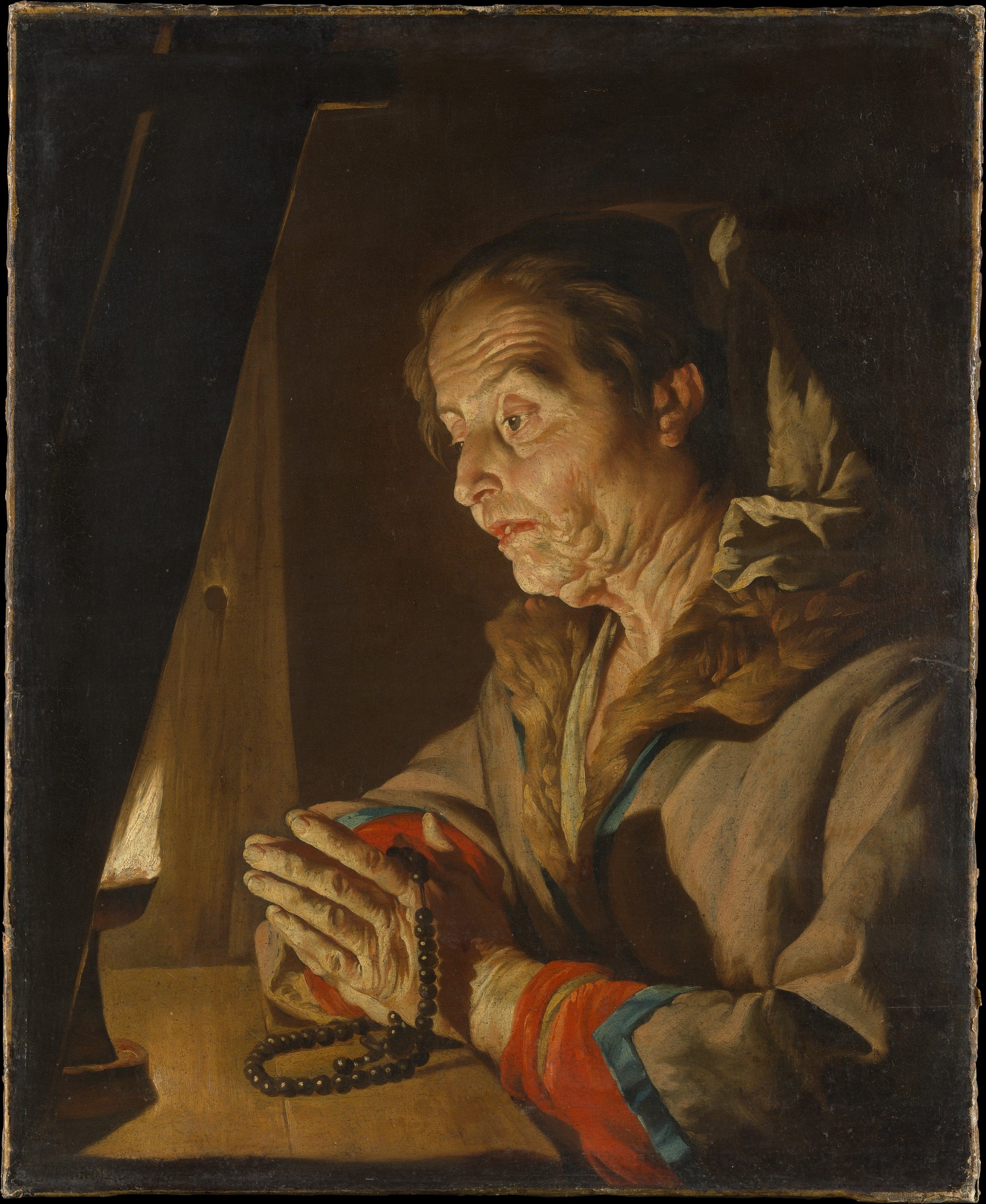
And then there is that great difficulty of words—what words should we say to this God when we only have words that are so unfit to serve? We humans only have words that we dreamt up for other purposes—to count livestock and the dead bodies of our enemies. Words we humans have not blushed to use as we went about our sinful purposes. Yes, words like Father and Kingdom. You hear from time to time that these words should be replaced. But I dare anyone to find a human word that has not been stained by blood and terror. Words like that do not exist. Even sacral words, religious words—these can be turned towards arrogance and boasting and death. St. Paul has been trying to get at this point all through the letter to the Romans, which we’ve been reading the last few weeks at Mass. When he speaks of the flesh, remember he’s not just speaking of those obvious fleshy sins: greed and lust and drunkenness and violence. Yes, those, but in addition, he’s also been trying to show how our entire oh-so-spiritual, oh-so-holy religion can become a work of the flesh—which is to say: it can be full of boasting and pride and self-reliance, and therefore oriented towards death, futility, and the grave.
So Kingdom, Father, the number 1 and the number 3. There are no clean words. There’s no pure language fit to serve the Holy God. But that is just the point, isn’t it? That God does not come down from heaven with an utterly pure language of his own, but he takes up the bloodstained words in all their sinfulness and conquers them and puts them into his service. When you pray, this God says, you will say the word “Father!” And you’ll say this word not in fear, not in terror, but because the Spirit of Love has touched this word and given it a new meaning, a truer meaning, its real meaning—the meaning it was predestined to have from the foundations of the world. And it’s this same Spirit that cries out this word from within you.
And if God can use these broken, bloodied words, there might be some hope for you and me—we who are bloodstained, we who do not look so good ourselves. We who are prone to boasting even as we kill ourselves with shame. If God can take some crooked word and use it to reveal the utter majesty of his own most inner life, what is stopping him from taking us and making us the sorts of people who say this word? So you see prayer is already God’s act of justification: the taking of the sinner and the sinful word into holiness, into grace. To say that we may pray “Father” is already to say that there is forgiveness of sins and new life in the heart of God.
So you can see: a good priest won’t remove the difficulties of prayer. But he’ll preach this free grace. He will preach the sanctification of the sinful word and he will preach the justification of the sinner.
In short, he will preach the Christian God. Not the god who is a brick wall. But the One God who is somehow Father listening to his children, but also the One God who is also the Spirit inside of us who makes the speech well up from within us—but also the One God who is somehow the Son who gives us this Spirit, the Son who gives us this white-hot flame and plants it in our hearts so that we are somehow burnished into his image, so that we somehow become just like him: sons of God. No marbles and brick walls here, but the tumultuous, beautiful life of the God who is Trinity roaring to life inside us and around us, saturating the world with grace, sanctifying what is bloodstained and making it holy.
I wonder what would happen if we began to think of prayer in those terms. Prayer wouldn’t be so much about us waiting for God to speak, but I think we’d have a sort of awe that words like “Our Father” rise to our lips. We’d keep speaking to God, knowing at every moment that these words we offer are not the product of our own ingenuity, our own self-reliance. No, we’d be stunned, knowing these words come to us from elsewhere. And with that wonder and with that awe, I think there would be many moments in life where we would want to make our spirit and our soul quiet, where instead of talking we would want to listen to that smoldering fire in our chest, alive with a word—but not just any word, no, but the very name of God.


